

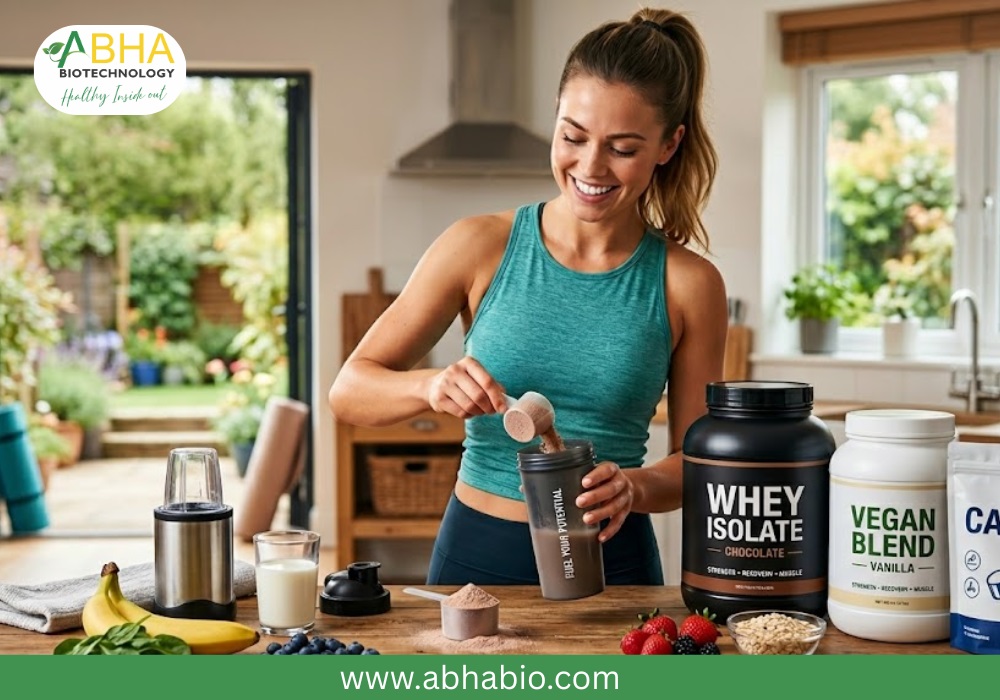
Most protein powders fail you in one of two ways. Either they taste like chalk dissolved in regret, or they hit your macros beautifully but feel like sandpaper going down. Rarely do you get both right, consistently, batch after batch.
Here's the thing: consistency is what actually builds brands. A product that tastes great the first time but disappoints on the third repurchase is a churn machine. Formulation stability, flavor integrity, and functional performance must be locked in together, not treated as separate problems.
This guide breaks down the science and strategy behind getting both right. And spoiler alert: it is not just about picking better flavors. Abha Biotechnology has spent considerable time in the formulation trenches, and what follows reflects how serious manufacturers think about this problem.
Why Most Protein Powders Fail on Taste?
Taste failure is not random. It is caused by specific, traceable decisions — or the absence of them. Let us diagnose the problem properly before throwing solutions at it.
Protein Source Impact
Not all protein is created equal — at least not in your mouth. Whey protein concentrate is relatively neutral, but plant-based proteins are a different beast entirely:
- Pea protein carries an earthy, legume-forward bitterness that is difficult to fully mask and tends to linger after swallowing.
- Soy protein often introduces a beany aftertaste that is polarizing at best. A lot of consumers have been burned by it.
- Rice protein is gritty by nature. Without the right processing, it feels like drinking lightly flavored gravel.
Processing Challenges
How the protein is made matters as much as what it is made from. Heat treatment during processing denatures proteins and can amplify bitterness. Hydrolysis — the process of breaking proteins into peptides for faster absorption — is also known to produce bitter compounds as a byproduct. These are not avoidable through flavoring alone. Solubility is another culprit. Poorly dispersed proteins clump at the bottom or form a gritty layer that no amount of shaking fixes.
Flavor Instability
A powder that tastes great on Day 1 can taste different by Month 6. Flavor compounds interact with proteins over time — particularly under heat, humidity, or light exposure. These interactions are well-documented but are often ignored during formulation. The result is a product that tastes inconsistent across production batches, which destroys brand trust faster than almost anything else.
Sweetener Pitfalls
The sweetener debate is real. Artificial sweeteners like sucralose are stable and intensely sweet, but consumers are increasingly suspicious of them. Natural alternatives have their own baggage: stevia has a distinct bitter tail at high concentrations, and monk fruit can leave a syrupy aftertaste. None of these are problems that cannot be solved — but they require deliberate formulation, not just swapping one sweetener for another.
Taste is not just flavoring — it is chemistry plus process control.
How to Build a Consistent and Great-Tasting Protein Powder?
Great taste is an engineered system. Here is how it is built, layer by layer.
1. Choosing the Right Protein Base
The protein base is where every formulation decision starts, and it is where the biggest mistakes are also made. Blended protein systems, such as whey plus pea, or casein plus rice — outperform single-source options in both taste profile and amino acid completeness. However, blends should be built on functional logic, not just marketing:
- Use whey concentrate for palatability and mixability. It is forgiving and broadly liked.
- Add plant proteins for sustainability positioning or allergen accommodation — but compensate for bitterness through masking agents or flavor layering.
- Avoid ingredient stacking driven purely by label appeal. Every added protein brings its own taste baggage that must be managed.
2. Flavor System Design
Flavor is not a single ingredient — it is a system with distinct layers. Think of it the way a perfumer thinks about fragrance: top notes (immediate impression), mid notes (body), and base notes (lingering finish).
A well-designed protein powder flavor system works the same way. Natural flavors are preferred by today's consumers, but artificial flavors offer better heat stability. Masking agents, compounds specifically designed to neutralize bitter or beany notes, are often underused. Emulsifiers and stabilizers are needed to keep the flavor system homogenous in the finished powder.
3. Texture and Mouthfeel Optimization
Mouthfeel is experienced before taste registers. If the texture is wrong, the consumer has already mentally checked out. Key levers include:
- Particle size reduction through milling to improve dispersibility — this directly reduces chalkiness and grittiness.
- Instantization using lecithin or sunflower lecithin, which allows the powder to wet and disperse rapidly in cold water without clumping.
- Foam control — over-mixed or poorly emulsified products foam excessively, which many consumers find unpleasant.
4. Smart Sweetening Strategies
Blending sweeteners is almost always better than relying on a single one. A combination of stevia and monk fruit, for example, can cancel out the worst aftertaste notes of each while delivering a cleaner sweetness profile. The balance must be calibrated against the base flavor system — a chocolate flavor profile needs a different sweetness approach than a fruit-forward one.
Great taste is an engineered system, not a single ingredient fix.
Manufacturing Consistency: The Hidden Differentiator
Even a perfectly formulated product can fail at the manufacturing stage. In fact, this is where most quality issues actually originate — not in the lab, but on the production floor.
Common Taste & Quality Failures: Root Causes at a Glance
|
Failure |
Root Cause |
Consumer Impact |
|
Bitterness/Aftertaste |
Hydrolyzed proteins, stevia overuse |
Abandon tubs, no repeat |
|
Gritty Mouthfeel |
Poor solubility, large particle size |
Perceived as low quality |
|
Flavor Degradation |
Protein flavour compound interactions |
Inconsistent taste across batches |
|
Chalky Texture |
No instantization, poor emulsification |
Low mixability ratings online |
Standardized sourcing is the first line of defense. Raw material variability, even from the same supplier — can introduce batch-to-batch inconsistency in taste, color, and texture. Proteins from different harvests, for example, can have meaningfully different flavor profiles.
Process control during mixing is equally critical: uneven flavor distribution results in some scoops tasting great and others tasting like nothing. Moisture control during blending and packaging affects shelf stability and powder texture. Batch testing and shelf-life validation are non-negotiable for brands that want to make claims about consistency.
Scalability is where R&D often breaks down. A formulation that works beautifully in a 10 kg batch can behave very differently at 2,000 kg. Experienced manufacturers understand these dynamics and build process tolerances accordingly.
This is precisely where manufacturers like Abha Biotechnology create real value — delivering repeatable quality across every batch, not just in the pilot run.
Consistency is built in manufacturing, not just in formulation.
The Bottom Line
Taste and effectiveness are not competing priorities, they are the same priority. Consumers want a product that works, tastes good every time they open a new bag, and holds up across six months of storage. Brands that deliver on all three dimensions will earn long-term loyalty. Those that do not will keep fighting churn.
The three pillars that make this possible are smart formulation, nutritional integrity, and manufacturing precision. None of these can be treated as optional. All three must work together, and they must work consistently at scale.
Partnering with the right manufacturer is what makes this achievable. The formulation expertise, sourcing standards, and production controls that produce consistent results do not happen by accident — they are built, tested, and validated over time.
Ready to build a protein product that delivers, every single batch? Let's talk.
Ready to Scale Your Nutraceutical Brand?
Partner with a manufacturer that understands your vision and delivers results.
Abha Biotechnology is dedicated to revolutionize India’s health supplement market with innovative science-backed product range. We focus on delivering the highest quality products at the most reasonable price so that your brand differentiates from the competitors. With flexible MOQs, customized formulations, and next-gen R&D, we are not just another third party health supplement manufacturer, we are your partner in growth and global reach.
Abha Biotechnology – Healthy inside out